


SIVALab joint laboratory
Laboratoire commun Renault – UTC – CNRS « Systèmes intègres pour le véhicule autonome ».
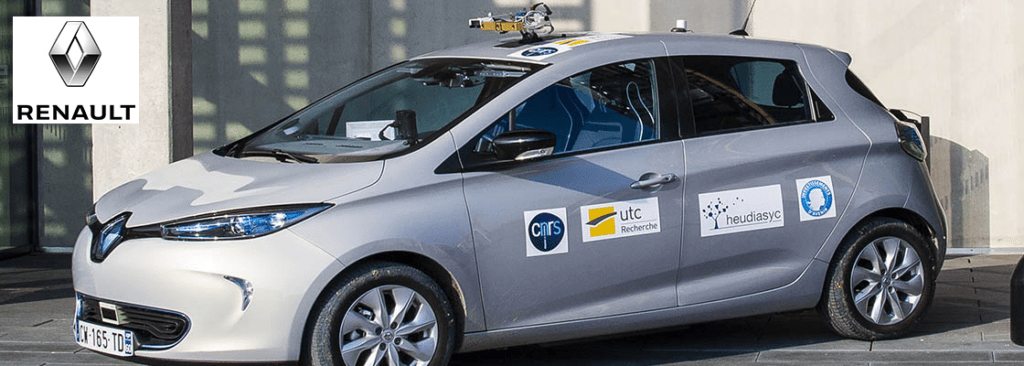
SIVALab (Integrity Systems Laboratory for Autonomous Vehicles)
From 2017 to 2025, Renault (Ampere) and Heudiasyc jointly coordinated SIVALab, a laboratory specialized in localization and perception systems for autonomous vehicles.
This scientific and technological partnership is the result of more than ten years of collaboration and builds upon Heudiasyc’s autonomous vehicle platforms, developed using Renault ZOE vehicles.
Research Areas
The main focus of the SIVALab joint laboratory is the integrity monitoring of information derived from perception, localization, and digital maps for Advanced Driver Assistance Systems (ADAS) and Autonomous Driving (AD) functions in intelligent vehicles. The concept of integrity is based on the combination and fusion of data from complementary, diverse, and redundant sources.
This information is consolidated within an environmental representation framework known as the World Model, which serves as the interface between the perception and localization modules and the decision-making module.
The objective of SIVALab is to ensure that the World Model provides reliable real-time information for situation awareness and understanding, enabling decision-making for ADAS and autonomous driving functions. This includes ensuring the reliability of perception, localization, and mapping information within a specified Operational Design Domain (ODD).
Projects and collaborations
ESCAPE : European project funded by the European GNSS Agency (GSA). Within this project, Heudiasyc participated through Renault, one of the project partners. The objective was to develop a high-integrity positioning system by combining the new capabilities offered by the European Galileo satellite navigation system with intelligent cameras and high-definition maps.
TORNADO : French FUI-funded project that investigates interactions between autonomous vehicles and infrastructure to enable mobility services in low-density areas. Field trials were conducted in Rambouillet in 2021 under real-world operating conditions on public roads.
ERASMO : project aimed at developing and demonstrating an advanced On-Board Unit (OBU) for automated driving. Leveraging the expertise of leading European industrial and academic partners—including Renault Group, Idneo, GMV, Kudan, and Septentrio—the project proposes a multi-sensor solution that combines multi-constellation GNSS signals with data from both internal and external vehicle sensors.
Experimentations
Key figures
- 3 postdoctoral researchers and 10 engineers recruited during the project period
- 20 Master’s students hosted as interns
- 14 PhD dissertations completed and 5 ongoing
- 15 journal publications and 55 conference papers
- 9 patents and 1 software package filed
- Around 10 workshops organized throughout the project period
CONTACTS
Heudiasyc – UTC | Véronique Cherfaoui
Mail : veronique.cherfaoui@hds.utc.fr
Ampere | Javier Ibanez Guzman